Set your alarm for 04:24 in New York—that’s the summer solstice hitting on 21 June 2026 at 08:24 UTC (09:24 London, 17:24 Tokyo). You get the year’s longest day up north, the shortest down south, and it happens in one instant. Convert it to your clock, note any daylight saving quirks, and plan something brave. I’ll nudge you through the why, the how, and the magic next—because timing this right changes everything.
What Is the Summer Solstice?

Why does one day feel like it’s holding its breath, then glowing a little longer just for you? The summer solstice is that hinge in the year when daylight stretches to its furthest reach, and you feel the sky saying, Go. It marks the Sun’s high arc, the pause at the top of the climb, the long exhale of light that invites you outside.
Think of it through seasonal metaphors: a wide doorway, a cresting wave, a match struck and held. Through poetic interpretations, you’re not just watching a moment; you’re meeting your boldness. Step into it. Use the extra light to reset habits, to wander, to listen.
I’ll admit, I chase this day like a kid with pockets full of plans, dropping a few, keeping the best. You can, too—choose spaciousness, choose play, choose courage. Let the brightness train your eyes for possibility, carry that spark forward.
Exact Date and Time in 2026 by Time Zone

Start with the official UTC timestamp, lock it in, then we’ll translate it city by city so you can see your exact moment—and plan that sunrise or toast. Want to know when that lands in New York, London, Tokyo, or Sydney? I keep a world clock open—nerdy, I know—and we’ll flag daylight saving quirks too: yes in most of the U.S. and Europe in June, no in Arizona, Hawaii, and much of Australia, so you don’t miss the solstice by an hour when the clock games kick in.
UTC Reference Time
At the core of every clock you check, there’s UTC—the steady heartbeat we’ll use to pin down the summer solstice of 2026, then translate it cleanly into your local time.
UTC is the reference frame, not a cage; kept honest by Atomic clocks, patched with Leap seconds, it gives you one firm moment to aim for. You don’t guess—you anchor, then adjust.
Note the solstice’s UTC stamp, add or subtract your offset, and ignore daylight-saving drama until check. Time zones feel like shifting sand; I trip too, breathe, recalc, smile.
Why care this much? Because catching the exact turning point feels electric.
Plan your ritual, hike, your rooftop cheer; set an alert, set your intention, set yourself free. One time, one truth, many choices—yours.
Major City Times
On your clock, we’ll pin the solstice to real cities you know—New York and LA, London and Paris, Nairobi and Dubai, Delhi and Singapore, Tokyo and Seoul, Sydney and Auckland—so you can feel the moment land where you live. The instant hits on 21 June 2026 at 08:24 UTC; use these city comparisons to ground your own timekeeping conventions. In New York it’s 04:24, in LA 01:24; London 09:24, Paris 10:24; Nairobi 11:24, Dubai 12:24; Delhi 13:54, Singapore 16:24; Tokyo and Seoul 17:24; Sydney 18:24, Auckland 20:24. Breathe it in; you’re right on time.
| City | Local date | Local time |
|---|---|---|
| New York | 21 June 2026 | 04:24 |
| London | 21 June 2026 | 09:24 |
| Tokyo | 21 June 2026 | 17:24 |
Set your intention; greet the sun, unafraid, today.
DST Considerations
You’ve got the headline times; now let’s talk about what your clock actually does with them—daylight saving can tilt the math. The solstice hits one instant worldwide, but your wall clock shifts it. In June 2026, most of North America and Europe are on DST, so your local stamp reads one hour later than standard. Arizona and Hawaii? No shift. Most of Latin America, Africa, and Asia? No DST either. Australia and New Zealand are in winter, off DST, so the moment lands earlier by the clock. Policy variability creates odd borders; cross a state line, lose an hour, or gain one. Check your city’s rules—I still set two alarms. Protect your rhythm—clock jumps have health effects. Breathe, plan, set reminders, enjoy bright light.
Why the Date Shifts From Year to Year

Because Earth’s trip around the Sun takes about 365.242 days—not a neat 365—the summer solstice won’t land on the exact same calendar date every year. You live on a planet that refuses to fit a tidy box, and that’s liberating. Calendars try to keep up. Leap years add a day, historical reforms reset the rules, and administrative lag means governments and institutions adopt changes on their own timelines. So dates drift, then get nudged back.
Earth refuses tidy boxes; calendars chase its wobble, leap days and time zones nudging dates back.


Here’s how to think about it:
- The orbit’s fraction stacks up; every year, a quarter-day rolls forward, and after a few years, the solstice appears a day earlier or later on your calendar.
- Leap-day corrections catch the drift, but they’re imperfect by design, trading precision for long-term balance.
- Time zones and UTC mark the exact solstice moment; depending on where you are, that moment may fall before or after midnight.
Northern vs. Southern Hemisphere Perspectives
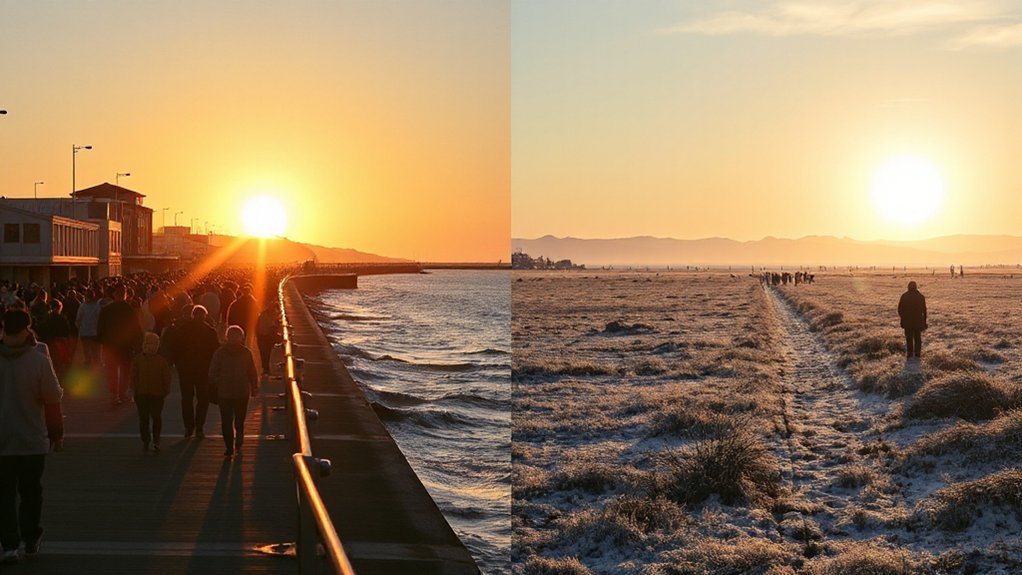
Dates wobble on the calendar, but meaning hinges on where you stand. If you’re north of the equator, the 2026 summer solstice sings of peak light, late sunsets, and open-road energy. South of it, you meet midwinter—a quiet, fire-lit pivot. Same day, different drum. You chase beaches; they tend hearths. And both choices are valid, brave. I’ll say it plainly: use this mirror. Ask what you need—expansion or rest—then claim it.
| Hemisphere | Mood | Traditions |
|---|---|---|
| Northern | Longest day, outdoor rush | Festivals, sunrise swims |
| Southern | Shortest day, reflective | Night markets, candle vigils |
| Northern | Plant care surges | Garden parties, trail runs |
| Southern | Soil sleeps | Story circles, slow cooking |
Freedom lives in alignment, not agreement. Agricultural calendars diverge, so your planning must, too. Borrow seasonal metaphors: light to start, dark to deepen. Plan a risk, protect a root. Choose your season, choose your story, then move with clear intent.
Astronomical Mechanics Behind the Solstice

While the calendar flips like any other day, the solstice is pure geometry in motion. You’re riding a tilted planet, leaning 23.4 degrees, and on this date that tilt points your hemisphere most toward the Sun. Picture an invisible cone tracing Earth’s axis as it precesses; I know, it sounds nerdy, but it’s your cosmic dance floor. Gravity, spin, sunlight—simple, wild, freeing.
- Think tilt: Earth’s axial lean sets the stage; the Sun’s rays strike more directly because of orientation, not closeness.
- Track wobble: precession and smaller nutation effects make the axis sway, shifting coordinates by tiny, relentless steps.
- Feel cycles: slow obliquity cycles change the tilt over millennia, tuning the background rhythm you inherit.
You don’t cause this, yet you can notice it. Look up, breathe, own the orbit. I’ll admit, I geek out, yet I’m moved, because mechanics become meaning when you pay attention.
Daylight Length and Sunrise/Sunset Highlights
You get the year’s longest stretch of light—about 14–15 hours in many cities, pushing 16–17 hours farther north. Watch the timing: the earliest sunrise often lands a week or so before June 20–21, while the latest sunsets hang on a week or two after—strange, I know, and I still check the app twice. So plan bold and simple—catch an early glow if your horizon allows, linger for that 9 p.m. gold if your latitude gifts it, and use this wide-open window to move, to meet, to make a memory.
Longest Daylight Span
How long can a day feel when the sun lingers like it hates goodbyes? On the solstice, you ride the longest daylight span, from a bold morning glow to a late, honeyed dusk. Your biological rhythms stretch, and your mental health can lift; light fuels momentum. Use it. Wander farther, laugh louder, breathe slower. I do, even when I overpack snacks and forget water. Claim the hours, then shape them.
- Plan a route with open views, pack simple fuel, chase shade at midday.
- Set a “pause alarm” to drink, stretch, and notice wind, birds, skin.
- Close with a small ritual—journal, campfire, barefoot walk—so the light becomes memory.
Let the long day teach you courage, patience, presence. You’ve got time—use it, and feel alive, today.
Earliest Sunrise Shifts
After claiming those long hours, the clock plays a quieter trick: the earliest sunrises slide in before the solstice, then drift later even as daylight still grows. You feel it on your skin at 5 a.m., cool air, wide streets, a hush that invites you to move. Blame Earth’s tilt and our not-quite-circular orbit; they shuffle the dawn. So plan boldly. Beat the alarm, slip outside, make space for the dream that keeps tugging you forward. Birds know this pattern—bird migration keys on light—so you can, too. Adjust commuter schedules, protect your mornings, defend that margin. I’ll admit, I used to hit snooze; now I lace up. What could you build with that extra sliver of sky? Claim it, breathe, begin before others wake.
Latest Sunset Highlights
At day’s end, the sky lingers, and the clock plays along: sunsets slide later even as the solstice has passed. You feel it, that extra slice of gold you can claim. I’ve chased it too, pocketing minutes like they’re tickets out of ordinary. The light lasts, you breathe easier, and plans stretch wider than the map. Horizon Colors deepen, then flare; Evening Fauna stirs at the edge of fields, curious, unhurried.
- Track your latitude and watch civil twilight extend, because the latest sunset often lands a week or two after the solstice.
- Drift outside tech-free; notice shadows shrink, neighbors wander, and songbirds trade shifts with bats.
- Set a tiny quest: bike to a west-facing hill, linger, and name three shades you almost missed tonight.
How to Celebrate the Longest Day
On this sun-soaked milestone, claim the day like it’s yours. Wake early, breathe deep, step outside before your phone wakes up. You’re chasing light, not notifications. Sketch a plan you can bend: adventure first, chores never. Aim your morning at motion—bike a river path, jog a ridge, or stroll the longest block in town. Pack water, fruit, a cheap disposable camera. At midday, make things: try Solar Crafts—sun prints, foil cookers, a suncatcher from found glass. I’ll fumble with the tape, you’ll laugh, and we’ll keep going.
| Dawn pulse | Barefoot stretch |
|---|---|
| Noon spark | Solar Crafts kit |
| Dusk glow | Daylight Games jam |
Turn afternoon into play. Host Daylight Games: frisbee relays, shadow tag, hopscotch grids that run like rivers. Invite who you want, or fly solo and race your own best time. Then soften. Sit still, write one brave sentence, promise yourself you’ll keep this light. All summer.
Cultural Traditions and Historic Sites
You’ve filled the day with motion and making; now let the world show you how others keep faith with the light. Walk toward places where stone circles still breathe, where drums rise, where bonfires mark a border between seasons. You’re not a spectator—you’re a link in a long chain, curious, open, hungry. I am too; I still get goosebumps at dawn rituals, then laugh at myself for tearing up in public.
Walk to breathing stones and bonfires; you’re a curious link carrying dawn’s trembling light.
- Visit ancient sites at sunrise or dusk, listen for old songs, read the plaques, and feel how heritage preservation keeps memory alive.
- Join neighborhood festivals, taste local cuisines, trade stories with elders, and learn why certain herbs, dances, and colors belong to this day.
- Make an offering—flowers, a poem, a quiet vow—and leave the place better than you found it, because gratitude stretches the light.
Take it in, give it back, carry it forward.
Tips for Observing Safely and Sustainably
Because light can dazzle and crowds can swell, plan like a scout and move like a guest. Start early, scout shade, and set a simple base—hat, sunscreen, map, and a shared plan if you get separated. I’ll admit, I overpack snacks; you should, too, but keep it clean: Eco Friendly Picnics with real forks, cloth napkins, a blanket you’ll use for years. Carry in, carry out, and leave the grass better than you found it.
Guard your energy. Hydration Tips matter: refillable bottle, a pinch of salt, fruit with water, steady sips, not gulps. Listen to your body; freedom fades fast if you’re woozy.
Move kindly. Take transit, bike, or walk when you can; noise down, eyes up, respect elders and sacred sites. Use a small headlamp after sunset, red light if possible. Check weather, know your exit, and buddy up. Celebrate the sun, not your footprint. Stay curious, grateful.