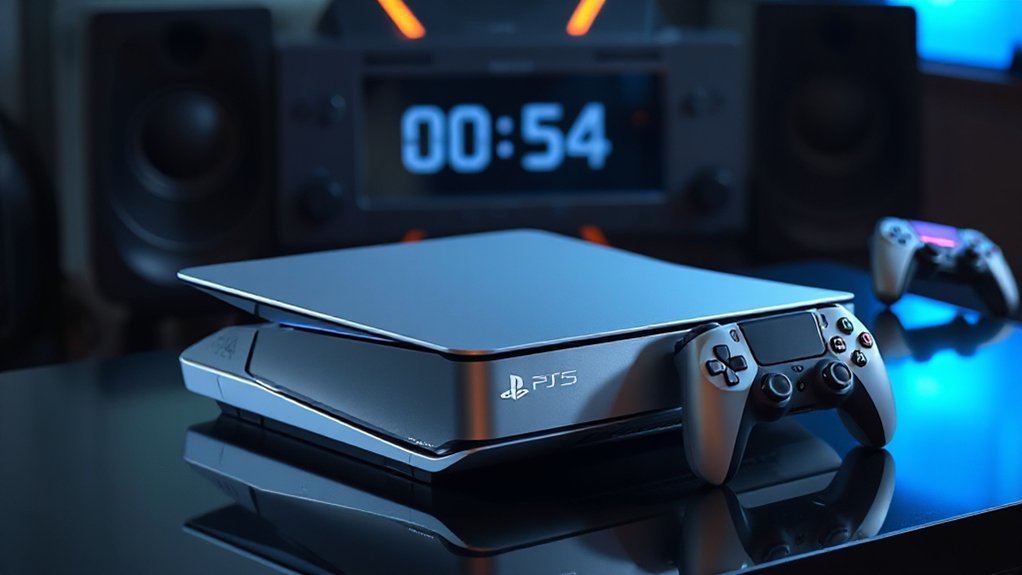
We often ask ourselves, “When will the PS6 arrive?” Based on Sony’s past pattern—six to seven years between consoles—we’re probably looking at 2026 or 2027. But here’s the thing: no official date, only rumors and industry whispers. They might showcase new tech like AI gameplay or cloud rendering, but timing depends on supply chains, innovation readiness, and market strategy. Curious to see how this all unfolds? Let’s explore what’s driving Sony’s next move.
Expected Release Timeline Based on Past Patterns

Since we’re often curious about when new tech drops, looking at the past is our best clue for predicting the PS6 release date. The PS console line follows a pretty steady generation cadence.
Historically, Sony releases new PlayStations roughly every six to seven years. For example, the PS4 launched in 2013, and the PS5 arrived in late 2020—about seven years apart.
These historical intervals give us a solid idea that Sony tends to stick to roughly that timeline, maybe a little longer or shorter. While we can’t say for sure, the pattern suggests the PS6 might land around 2026 or 2027.
It’s like clockwork—Sony’s made consistent moves, timing their releases to build excitement and meet demand. So, if history’s anything to go by, we’re looking at some exciting years ahead, with plenty of speculation until Sony makes the official call.
Industry Rumors and Official Statements

When it comes to the PS6, rumors are swirling faster than we can keep up, but not all whispers are created equal. Some leaks look promising, but we’re aware better than to believe every tweet or photo. That’s where leak verification comes in—balancing hype with facts, we sift through the noise.
Official statements from Sony are rare but crucial; they sometimes drop hints during investor calls or surprise announcements, helping us gauge reality. Recently, a few exec interviews shed light on Sony’s mindset, even if they didn’t give us a firm date.
These chats tell us Sony is focused on innovation, not rushing, which means the PS6 might still be a ways off. Still, it’s exciting to watch how rumors morph into potential plans.
Anticipated Features and Technological Innovations

Whenever we talk about the PS6, one thing’s clear—people are excited to see what kind of tech wizardry Sony’s been cooking up. We’re betting on AI integration becoming a game-changer, making interactions smarter, more intuitive, maybe even adding personalized game experiences. Imagine AI that adapts difficulty levels or predicts what you want before you ask.
Cloud rendering is also likely to take center stage, pushing graphics beyond what’s possible locally. This means smoother gameplay, richer visuals, and faster load times, because the heavy lifting happens somewhere in the cloud—not just your console. Think about seamless streaming of huge worlds, instant access to games without waiting, and fewer hardware limitations.
Of course, Sony’s proven they love pushing tech boundaries. As fans, we’re excited about these innovations—because they’ll not only make games prettier but smarter, more immersive, and a lot less frustrating to run.
Impact of PlayStation 5 on the Development Cycle

The PlayStation 5 didn’t just bring new games; it reshaped how developers approach their craft.
One key change? Tooling evolution—our tools now do more than ever, thanks to advanced SDKs and faster hardware. These improvements let developers prototype faster and test more complex ideas without waiting for ages.
But it’s not just better tools—workflow compression has taken center stage. Development cycles are squeezed tighter, so teams are working smarter, not harder.
We’re streamlining processes, removing redundant steps, and relying on automation like AI-driven testing. This means more frequent updates, quicker bug fixes, and faster push-to-market timelines.
It’s a double-edged sword—shorter cycles demand sharper focus, but they also ignite creativity. Overall, the PS5’s tech boasted a seismic shift, making the entire development cycle more agile, more efficient—and honestly, pretty exciting for everyone keen for the next big hit.
Factors Influencing Sony’s Launch Strategy

Sony’s launch strategy for the PS6 isn’t just about timing; it’s shaped by a mix of market trends, technological innovations, and what gamers are hungry for next.
One key factor is manufacturing capacity—if Sony can’t produce enough units, launching too soon risks shortages and frustration. They need to make certain they can meet demand without causing chaos.
Then there’s marketing spend. Sony’s budget for promoting the PS6 shows how serious they’re about dominating the market. Heavy marketing creates buzz, but it also signals confidence in a ready product.
Timing the launch involves balancing these factors—pushing out when the tech is ready, and their supply chain can handle it, while also feeding the hype. If they rush, sales could crash; if they wait too long, gamers might lose interest.
It’s a delicate dance—getting it right means understanding these concrete steps, even amid unpredictable world events.
Conclusion
So, when’s the PS6 arriving? Based on past patterns, probably around 2026 or 2027, give or take a year. Sony tends to follow a roughly six-to-seven-year cycle, but delays happen—and thanks to the PS5’s recent launch, early surprises are unlikely. We’ll see upgrades like faster load times, AI tweaks, and cloud gaming. Patience is key, folks. Until then, enjoy what we’ve got—because when the PS6 hits, it’ll be worth the wait.
